
Closing Line Value on Home Run Props: How Sharps Beat the Book
 Available in US
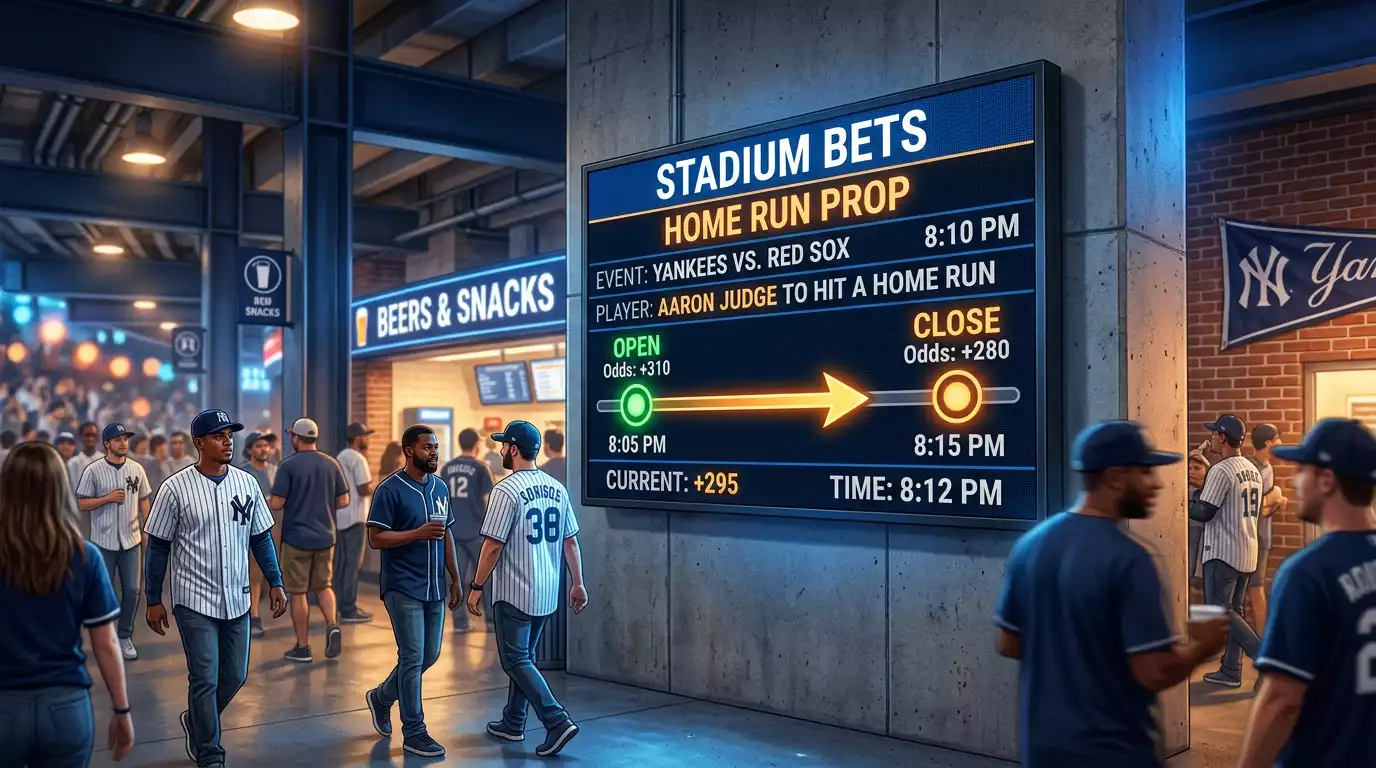
I once spent two weeks of evenings comparing my opening prices on home run props with the closing prices on the same markets, and the result was the most uncomfortable spreadsheet I have ever produced. I was placing bets at +400 that closed at +320 about a third of the time, which felt like proof I was a genius. The other two-thirds of the time, I was placing bets at +400 that closed at +500, which is a quieter but more devastating signal – the market was telling me I had been wrong, before the first pitch was even thrown. That spreadsheet rewired my entire approach to the prop market, because it taught me that closing line value is not a vanity metric. It is the only honest measurement of whether you actually know what you are doing.
The One Number That Tells You Everything
Closing line value is the difference between the price at which you placed your bet and the price at which the market closed. If you backed a slugger to homer at +400 and the line closed at +300, you got closing line value – the market moved in your direction, suggesting that newer information confirmed your read. If you backed him at +400 and the line closed at +500, you got negative closing line value, and the market is whispering that you missed something the rest of the bettors picked up on as the day progressed.
The reason CLV matters more than your win-loss record over short stretches is variance. Home run props carry odds quoted from around +200 (about 2.90 in decimal) and stretch beyond +1000 on long-tail outcomes, and at those prices you can be a brilliant bettor and lose seven of ten tickets in a single week. The maths simply does not care about your feelings. CLV, by contrast, is computable on every bet you place, regardless of outcome, and over a few hundred tickets it will tell you whether you are actually beating the market or just enjoying the occasional warm wind of variance.
Professional bettors track CLV obsessively because it is forward-looking. Win-loss tells you what happened; CLV tells you whether your process is sound. A bettor who consistently gets CLV will make money over time, because the market closes near the true probability, and beating the close means you are placing bets at better prices than the consensus.
How Closing Lines Get Built on the Prop Board
Understanding why CLV matters requires understanding what the closing line actually represents. The opening line for a home run prop is published by the trader based on a model – a combination of player projection, park factor, pitcher matchup, and recent form. From there, the line moves in response to two forces: sharper bettors getting in early at favourable prices, and the market absorbing late-breaking information like lineup confirmations, weather updates, and bullpen news.
By first pitch, the closing line has incorporated all of that. It reflects the consensus of every bet placed, weighted by the size of those bets. Sharper money carries more weight because traders adjust faster to actions from accounts with proven track records. Public money still influences the line, but on niche markets like HR props, the public-to-sharp balance is more even than on a major NFL spread, where public action drowns out everything.
This is why the closing line on an HR prop is, on average, the most accurate single estimate of the player’s true HR probability you can find. Beating it consistently means you are extracting information from the market faster than the market can process it. That is genuinely hard, and it is the only path to long-term profit on a prop board where the books take their margin from the same pool you are drawing from.
Where the Easy Closing Line Value Comes From
The good news for an attentive amateur is that the bookmaker’s opening line is rarely as good as the closing line. The trader is publishing dozens of HR props per slate, and they are working with a finite amount of attention. The lines that get the most analytical love are the ones with the highest expected handle – top sluggers in marquee games. Mid-tier hitters in less-watched matchups get worked through faster and with less granular adjustment. That gap between effort and accuracy is where amateur edge lives.
I get most of my CLV from three specific situations. The first is overnight openers – when books publish HR props the evening before the game, often before lineups are confirmed. If I have a strong read on which lineup is likely and the trader has used a default expectation, I can place a bet that gets repriced when the lineup is announced. The second is pitcher confirmation – when a probable starter gets ruled out and a less-imposing arm steps in. The lines for hitters in that game tend to drift, and getting in before the broader market reacts is consistently profitable. The third is weather. Forecasts updating from “partly cloudy” to “warm and breezy” should move HR prices, but they often move slowly, especially on smaller books.
For a UK punter, weather monitoring is harder because the games are happening on the other side of the Atlantic and the relevant forecasts are American. I built a small habit of checking the National Weather Service site for the cities of any games I am betting, around three to four hours before first pitch. That window is long enough for the forecast to settle but tight enough that the books may not yet have reacted. Bet365’s MLB market timing, which I cover in detail elsewhere, is one of the more reliable spots to find this kind of pre-confirmation drift.
Tracking CLV Without Losing Your Sanity
The honest tracker setup is a spreadsheet. Date, player, market, opening price, my price, closing price, stake, result. Every bet, every time, no exceptions. Most punters refuse to do this because it is tedious and because looking at your full betting history is occasionally psychologically painful. But the spreadsheet is the only thing that will tell you whether your process actually works.
The mechanics are simple. Convert each price to implied probability using the standard formula. The CLV per ticket is the difference between the closing implied probability and your placed implied probability, divided by your placed implied probability. So if you bet at +400 (20% implied) and the line closed at +300 (25% implied), your CLV is positive five percentage points, or 25% in relative terms. Average that across a hundred tickets and you have a real number.
For HR props specifically, sustained CLV of plus three to five percentage points is excellent. Anything above plus five is professional-tier and probably means your sample is small enough that variance is helping. Anything below zero, sustained, means your process needs serious work, regardless of what your win-loss record looks like. I have known punters with positive ROI over short stretches who had negative CLV, and every single one of them eventually gave back their winnings to the market.
The Trap of Positive CLV With Negative ROI
Here is a scenario that stumps a lot of new bettors. You track your CLV religiously, you average plus four points across a hundred tickets, and yet your bankroll is down. What gives? The answer is usually one of two things, and both are fixable.
The first is variance. A hundred tickets is not a large sample for HR props at +400 prices. You can be genuinely positive EV and still lose money over that stretch. The CLV signal is telling you the truth – your process is sound, the variance is just running cold. Hold the line, keep placing the same bets, and the EV will assert itself over five hundred or a thousand tickets.
The second is staking. If you are getting CLV but staking inconsistently – bigger on the bets that “feel right” and smaller on the bets that are actually mispriced – you can outperform the market on price and underperform on bankroll growth. The fix is mechanical staking, ideally a fractional Kelly approach or a flat percentage of bankroll per ticket, regardless of how confident you feel.
The combination of positive CLV and disciplined staking is what produces durable profit. Either alone is insufficient. CLV without discipline is information you are failing to monetise. Discipline without CLV is consistent management of a losing process. Both together is the mark of a serious bettor.
What CLV Cannot Tell You
For all its usefulness, CLV is not a complete picture. It tells you whether your bets are priced better than the close, but it does not tell you whether you are getting access to those prices in the first place. Plenty of UK punters have found that their accounts get restricted or limited shortly after they start posting consistent CLV. Memory from UKGC research in 2025 shows 4.3% of British betting accounts faced restrictions, and 51.69% of those restricted accounts were closed by operators citing ‘commercial reasons’. That is the polite term for “you are winning too consistently, please leave”.
The implication is that CLV without longevity is theoretical profit. If you can only get CLV for two months before your maximum stake on HR props gets cut to a fiver, you have not really beaten the market – you have temporarily outwitted a single book before being filed under “uneconomic to do business with”. Sustainable CLV requires not just sharp pricing, but operational care: spreading action across multiple books, varying stake sizes, occasionally placing recreational losers to muddy the pattern. None of this is glamorous, and all of it is part of the genuine professional approach.
The Patience That Builds Real Skill
I started this article by talking about a two-week project that rewired my approach. The deeper truth is that building a CLV-positive process takes years, not weeks. Most amateurs quit after a couple of months because the variance is brutal and the spreadsheet is boring. The ones who stick with it discover, sometimes quite slowly, that the same instincts that felt like magic in their first profitable summer were actually a thin veneer of luck on top of a lot of marginal decisions. CLV strips that veneer away. It tells you what your process is actually worth, in numbers, and it gives you a target to improve against. There is no other tool in the prop bettor’s kit that does the same job, and there is no path to long-term success that avoids it.
What does closing line value mean for home run props?
It is the difference between the price you placed your bet at and the price at which the market closed. If your price was better than the close, you have positive closing line value, which suggests your process is sharper than the market average. Positive CLV is the strongest leading indicator of long-term profitability, especially in high-variance markets like home run props where short-run win-loss results can mislead.
Why should I track CLV if I am already tracking my win rate?
Win rate is a lagging indicator distorted by variance. CLV is forward-looking and computable on every bet, regardless of outcome. Across a few hundred tickets, your CLV average will tell you whether you are genuinely beating the market or simply riding short-term luck. Two punters with identical win rates can have wildly different CLV profiles, and the one with positive CLV is the one heading for long-term profit.
Written by the editors at mlb Prop Bets Home Runs.