Pitchers’ Parks: Why PNC and Busch Stadium Eat Home Run Bets
 Available in US
I lost a lot of money on PNC Park before I learned to respect it. There was a stretch in 2018 and 2019 where I kept backing visiting power hitters in Pittsburgh, watching them roll up barrels, and watching those barrels die on the warning track. I told myself the wind had been against them. I told myself I was running cold. The reality, which it took me a humiliating amount of time to accept, was that PNC Park is a graveyard for home runs and my model was simply wrong about it. Now, several years on, the data has caught up with what felt at the time like a personal vendetta. PNC and Busch Stadium are the two genuine pitchers’ parks of the modern MLB. Punters who understand how they distort HR markets have an edge. Punters who do not get systematically clipped, the way I did.
The Numbers That Define the Two Parks
PNC Park finished 2025 as the toughest park in MLB for home runs with an HR park factor of 66, with Busch Stadium next at 77. To make sense of those numbers: a park factor of 100 is league average, anything below 90 is suppressive, and anything below 75 is genuinely punishing. PNC at 66 means that for the same hitter against the same pitcher in the same weather, you should expect 34% fewer home runs in Pittsburgh than at a league-average park. Busch at 77 means 23% fewer. Those are not subtle effects. They are the physics of the park overwhelming everything else in the matchup.
What makes the two parks pitcher-friendly is not one thing but several. PNC has the deepest right-centre alley in the National League, the high Clemente Wall in right field – although that wall actually catches some doubles that would have been homers elsewhere – and a wind profile that, in the cooler months, blows off the rivers and into the hitters. Busch has long power alleys, a heavy summer atmosphere when the Mississippi humidity stalls over the field, and outfield dimensions that punish anything short of a true power swing.
What This Means for the Standard Prop Market
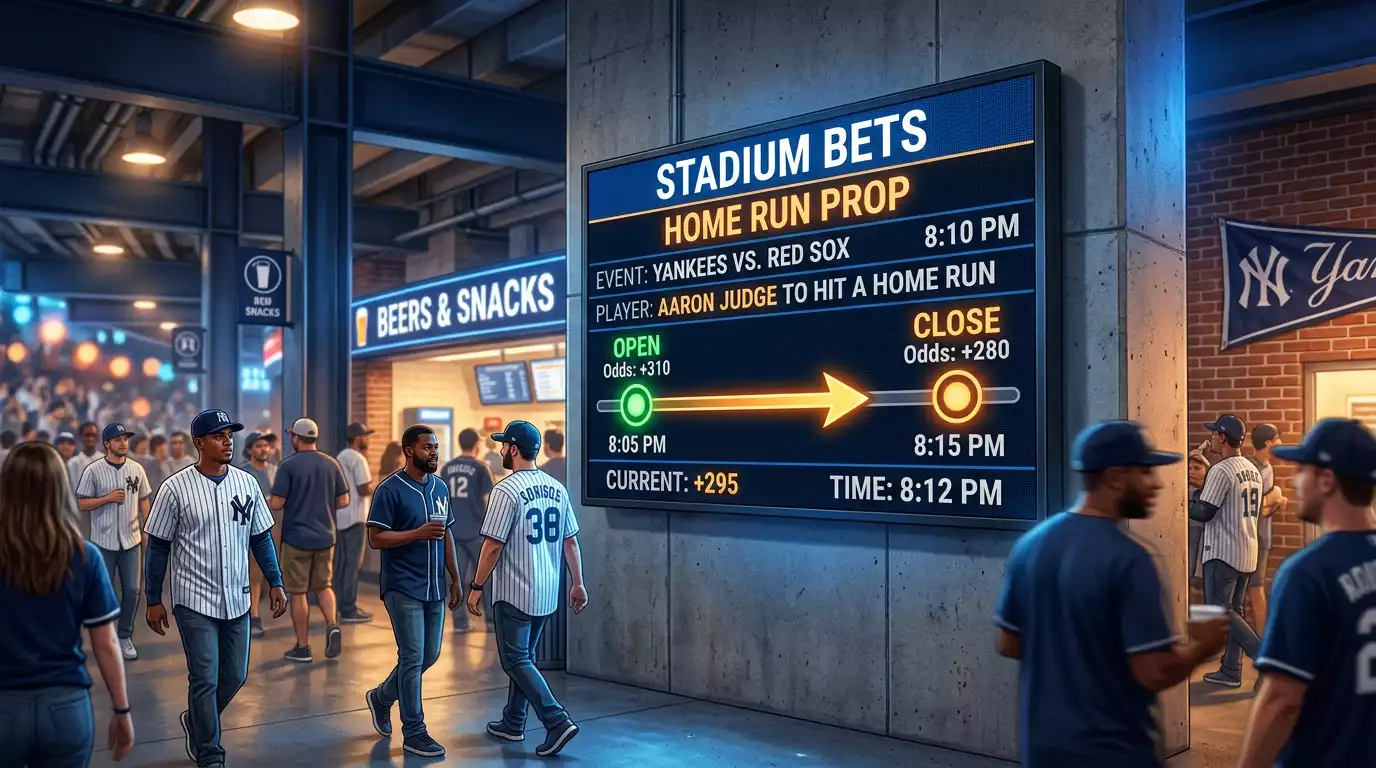
The to-hit-a-HR market on a star hitter at a typical park usually prices in the range of +200 to +1000 depending on bat quality, with most regulars sitting around +300 to +500. At PNC the same hitter in the same matchup should fairly price 50 to 80 cents wider on the moneyline. Most operators do shift the line. The question – and this is where the work happens – is whether they shift it enough.
My experience over several seasons of monitoring is that the answer is usually no. The line typically moves by 30 to 50 cents when it should move by 50 to 80. The discount on the price is real but undersized. That gap is small per game but, repeated across the 81 home games each park hosts, is large in aggregate. It also means the obvious bet is rarely the right one. Backing a Pirates hitter to homer at home, or a Cardinals hitter at Busch, is structurally a losing position even when the matchup looks favourable on every other dimension.
The Carry Math That Drives It
To explain why the suppression is so consistent, it helps to think about distance rather than home runs. A ball that travels exactly 400 feet at Yankee Stadium will travel approximately 408 feet in Atlanta and up to 440 feet in Denver due to atmospheric and altitudinal differences. Pittsburgh and St Louis sit on the suppressive end of that spectrum. PNC’s elevation is below 800 feet but the riverside humidity in summer is the dominant factor; Busch’s altitude is similar but the atmospheric weight in mid-summer is even heavier.
The carry difference between an extremely hitter-friendly park and a park like PNC is on the order of 8 to 12 feet on a typical 400-foot fly ball. That sounds small. But the distribution of fly-ball distances is sharply peaked around the warning track for any given pull-side launch. A 10-foot reduction in carry at the right place in that distribution is the difference between a no-doubt home run and a routine flyout. That is precisely why suppressive parks generate not just fewer home runs but also more “almost” outcomes – barrels that die, balls that bounce off the wall, drives that get caught at the track. The aggregate visual impression is of unlucky power hitters; the actual cause is geometry plus air.
The Under Side of the Market
This is where pitchers’ parks become genuinely useful for HR-prop punters. The standard market – will player X hit a home run today – is already shaded for the park, even if not enough. The under side of the equation, including the no-HR-prop market where some operators offer it, and the alternate 0-HR markets, tend to be priced more carefully because the bookmakers know that pitcher-park unders are exactly where sharp money concentrates.
The play I keep coming back to is not betting against a specific hitter going yard at PNC. The play is being structurally sceptical of any HR prop on a Pirates home game, period – and being especially sceptical of parlays that lean on Pirates home games for their power leg. Parlays that include a HR prop at a suppressive park run roughly 3 to 4 percentage points of negative EV per leg compared to the same parlay built at neutral parks, and that compounds quickly. If you are tempted by a multi-leg HR play and one of the legs is at PNC or Busch, swap that leg for something else, even at slightly worse odds.
The Visiting-Hitter Trap
The most common mistake I see, including from experienced punters, is the assumption that an elite visiting hitter “will hit anywhere”. The Statcast data does not bear this out at the suppressive parks. Even hitters with 90th-percentile barrel rates show roughly 25 to 30% fewer home runs at PNC than at neutral parks across multi-season samples. The hitter is the same; the conditions are not. Park effects are not a tie-breaker that gets overruled by talent. They are a primary input that talent partially mitigates but does not erase.
The corollary, which is more controversial in punting circles, is that a power hitter who racks up a hot streak in Pittsburgh or St Louis is doing something genuinely impressive – and the market often over-reacts the next time he plays at home. I have made decent money fading the visiting power hitter who just hit two home runs at PNC in a series, then comes home to his own park. The market drifts his price too short on the strength of those PNC home runs, ignoring the structural difficulty of producing them in the first place.
It is worth comparing this profile to the opposite end of the spectrum, where venues like T-Mobile Park favour specific hitter handedness in measurable ways – the asymmetry pattern there is its own market problem and works in the inverse direction.
How I Bet These Parks in Practice
My working rules are short. First, I do not back to-hit-a-HR props on Pirates home games unless the matchup is extraordinary on every other axis – a top-tier visiting power bat against a fifth starter with a 2.5+ HR/9 rate, in clear hot weather. Even then, I size the bet at half my standard unit. Second, I treat any 2-plus HR alternate line at PNC or Busch as roughly off-limits, because the suppression compounds nonlinearly on those markets. Third, I look for unders on team-total HR markets at these parks when the lines are set conservatively; that is where the operators sometimes get a little soft, especially in early-season cool weather.
Beyond that, I treat PNC and Busch as the cleanest park-factor evidence available that the home run market is not perfectly efficient. The structural mispricing is small per bet, but it is real, and it is exploitable for punters who are willing to bet against the visual narrative of “well this guy hits everywhere”.
The Park as a Filter, Not a Bet
The right way to use the pitchers’ park information, in my experience, is as a filter on the rest of your screen. Before I even look at a HR prop, I check the venue. If the venue is PNC or Busch, the prop has to clear a higher bar to make my list. If it does, I bet it slightly smaller than I would at a neutral park, because variance is higher and the real edge is narrower. If it does not, I move on.
This is the unglamorous side of HR-prop punting, and it is also where the durable money is made. Recognising the parks that systematically eat home run bets, and respecting that data even when the matchup looks juicy, is one of the cleanest ways to lift your long-run win rate without changing anything else about your process.
Are unders on HR props always sharp at pitchers’ parks?
Not always, but they are consistently the safer side when the price is set tight. The bookmakers know suppressive parks attract under bets, so they tend to price the no-HR market more carefully than the over. The cleanest unders come on team-total HR props rather than individual to-hit-a-HR markets, and especially in early-season cool weather when the suppression compounds.
Do visiting power hitters overcome PNC’s suppression?
Less than the market assumes. Across multi-season samples, even hitters with 90th-percentile barrel rates show roughly 25 to 30% fewer home runs at PNC than at neutral parks. Talent partially mitigates park effects but does not erase them, which makes visiting hitters at PNC a structurally weaker prop than the headline matchup suggests.
Is Busch Stadium really comparable to PNC for HR suppression?
The 2025 numbers – PNC at 66, Busch at 77 – show Busch as suppressive but meaningfully less extreme. Busch’s effect is more weather-dependent: the heavy mid-summer humidity is what drives the suppression, so the park plays closer to neutral in cool spring or autumn games. PNC suppresses more consistently across the season.
Prepared by the mlb Prop Bets Home Runs editorial staff.